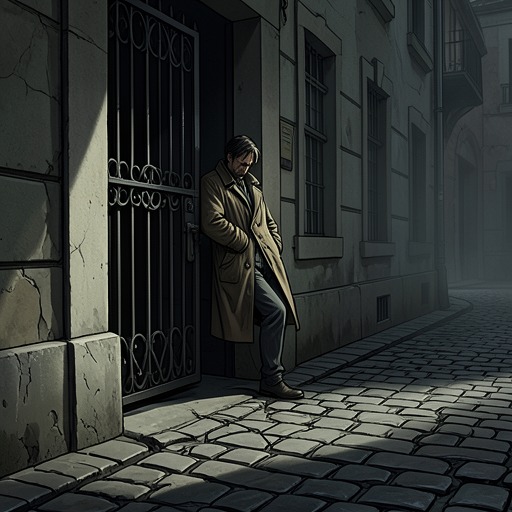
Javier Fumero
The Shadow of the WindJavier Fumero’s decisive significance is the continuity between his wartime violence and his postwar authority. Identified as the killer of Clara Barceló’s father and the torturer of Fermín Romero de Torres, he becomes a police inspector after Barcelona falls, carrying personal brutality into the institutions of the new order.
Identity and Background
Clara recounts that her mother’s search for the truth about her father ended with two recovered clues: a broken wristwatch and the name of the man who had killed him at Montjuic Castle. That man was Fumero. He had, by her account, moved among competing political forces during the war, beginning as a hired gunman associated with the FAI, then approaching communists and fascists while selling his services to the highest bidder. After Barcelona fell, he joined the police on the victorious side and became a decorated inspector. His career is presented less as a change of conviction than as a successful adaptation to whoever holds power.
Authority and Intimidation
Fumero’s official position gives his threats a reach beyond private vengeance. When he visits the Sempere bookshop, he displays his police identification and identifies himself as Chief Inspector Francisco Javier Fumero. He threatens Daniel Sempere and his father with trouble over the supposed sale of communist material, turning a shop counter into a demonstration of how easily police authority can silence ordinary people.
Fermín Romero de Torres also knows Fumero as an active pursuer. While living on the streets, Fermín has been devising ways to evade the security services, especially the inspector, whom he regards as his nemesis. The fear is not abstract: Fermín’s knowledge that Fumero is looking for him shapes his apprehension when Daniel brings him to the bookshop and later helps explain why the family arranges lodging without the police-required guest registration.
The Arrest and Fermín’s Torture
Fermín later explains that during the war he had monitored figures such as Fumero, whom he considered dangerous because they shifted allegiance without scruple. After Barcelona fell, Fumero led the purge; Fermín was arrested at the port while trying to secure passage to France for some of his superiors. He was held at Montjuic Castle, where Fumero and a German-speaking accomplice tortured him to force him to disclose where those superiors were hiding. Fermín eventually gave them names and other identifying information, and was abandoned injured in an alley in Pueblo Seco. The scars Daniel had noticed were therefore not an unexplained mark of Fermín’s past but evidence of Fumero’s wartime violence.
Continuing Threat and Private Vengeance
Fumero’s authority remains a personal danger to Fermín long after the torture that left him scarred. When Fumero encounters him at the Hospice of Santa Lucia, he threatens to take him to headquarters and torture him again, while also menacing Daniel, the young person accompanying him. Fermín challenges him to leave Daniel alone, but Fumero answers with mockery. The exchange shows how readily he uses the prospect of official custody and renewed violence to intimidate both his old target and anyone who stands beside him.
His threat extends beyond Fermín to the people connected with the search for Julián Carax. In a later confrontation with Nuria, Fumero strikes and frightens her, then declares that he will find her missing husband and kill them both. He also reveals that he knows the woman Carax sent to her death was his sister, making the family secret part of his threat. Across these encounters, Fumero’s violence joins police power to intimate coercion: he seeks information and control through fear, and his pursuit reaches beyond his immediate adversaries to those who might shelter or help them.
Continuing Threat and Private Vengeance
Fumero’s authority remains a personal danger to Fermín Romero de Torres long after the torture that left him scarred. When Fumero encounters him at the Hospice of Santa Lucia, he threatens to take him to headquarters and torture him again, while also menacing Daniel Sempere, who is with him. Fermín challenges him to leave Daniel alone, but Fumero answers with mockery. The exchange shows how readily he uses the prospect of official custody and renewed violence to intimidate both his old target and anyone who stands beside him.
His threat extends beyond Fermín to people connected with the search for Julián Carax. In a later confrontation with Nuria, Fumero strikes and frightens her, then declares that he will find her missing husband and kill them both. He also reveals that he knows the woman Carax sent to her death was his sister, making the family secret part of his threat. Across these encounters, Fumero’s violence joins police power to intimate coercion: he seeks information and control through fear, and his pursuit reaches beyond his immediate adversaries to those who might shelter or help them.